
On the stage of industrial production, there is an “invisible glutton” – the compressed air system, which often accounts for a large proportion of total energy costs. But as long as you master the “secret book” of optimization strategies, it can transform from a “money eater” to a “cost saver”. Today, Bolaite will take you to unlock efficient optimization strategies for compressed air systems!
The compressed air system is not just a “hard laborer” driving tools, but also a key link in enterprise energy consumption and operating costs, known as the “fourth utility” after electricity, gas and water. When it operates efficiently, there are numerous benefits:
- Save electricity bills: Directly reduce energy consumption, resulting in considerable savings on electricity bills.
- Save maintenance costs: Reduce equipment wear and tear, leading to a significant drop in maintenance costs.
- Improve productivity: Minimize downtime, increase productivity, and ensure better product quality!
“Pressure” is the “core parameter” of the compressed air system. Most industrial air tools are designed to operate at 6 bar. However, pressure will quietly “leak away” on the path from the compressor to the tool, so the compressor pressure needs to be slightly higher.
Too low pressure is like a deflated ball, with greatly reduced performance and frustratingly slow production speed. For example, if the pressure of a drilling machine drops from 6 bar to 5 bar, the output may decrease by 25%!
Too high pressure is also not good! Increasing from 6 bar to 9 bar may seem to increase tool intensity by 50%, but overloaded operation will significantly shorten service life, cause maintenance costs to soar, and air consumption and energy consumption will also rise accordingly.
The consumption of compressed air changes with the operating pressure. The following are the correction coefficients corresponding to different operating pressures (unit: bar):
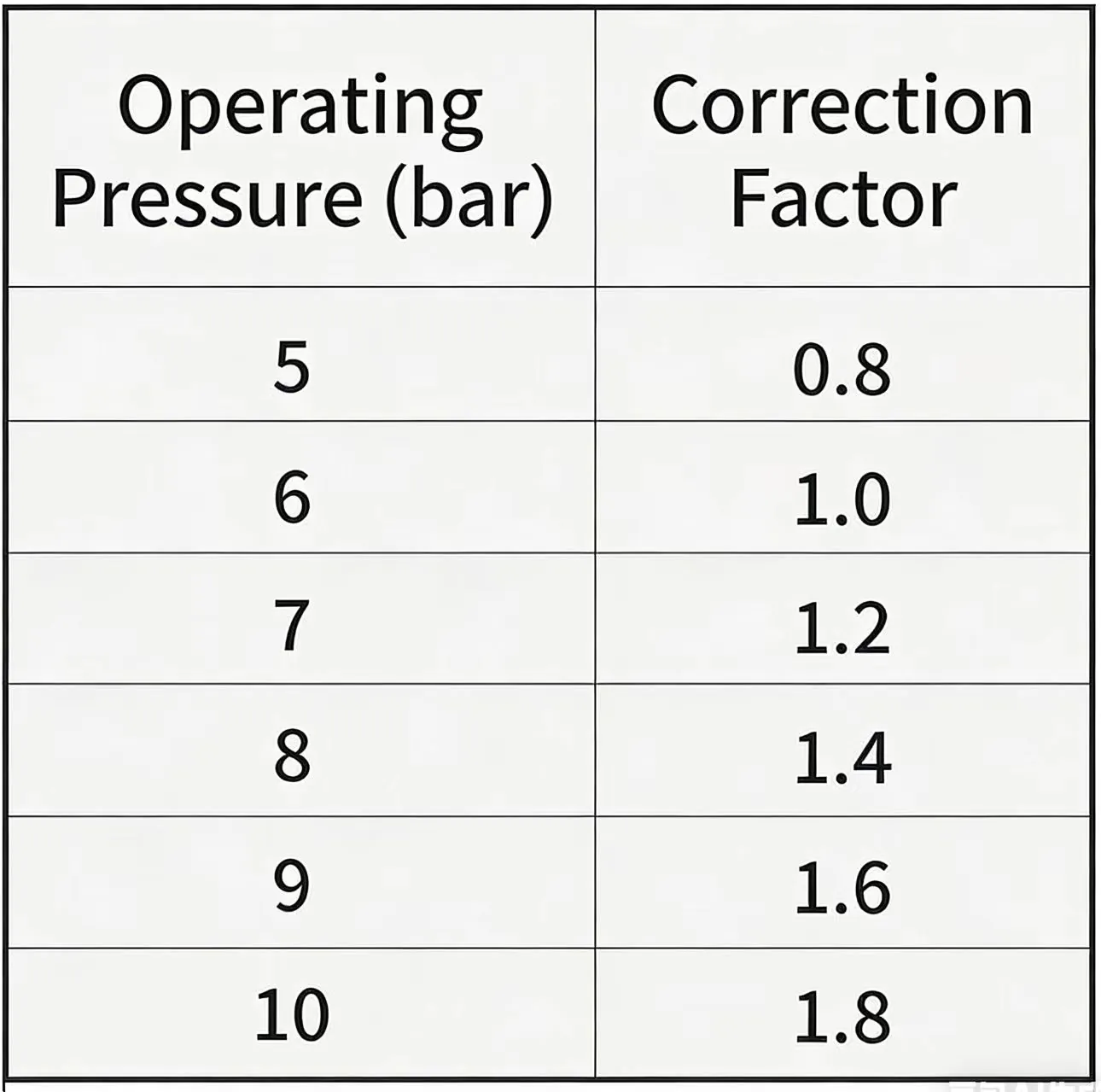
For example, there is a grinder that consumes 0.7 cubic meters of compressed air per minute when the operating pressure is 6 bar. When the operating pressure increases to 9 bar, its compressed air consumption per minute becomes 1.12 cubic meters. This example shows that changes in operating pressure will lead to significant changes in compressed air consumption. Therefore, reasonable optimization of operating pressure is very important for saving energy and reducing costs.
Moisture in compressed air is a hidden “system killer”. Without a dryer, it will:
• Corrode pipelines and machinery, shortening equipment service life.
• Accelerate the wear of pneumatic tools, increasing maintenance frequency.
• Increase the maintenance work of water separators and filters.
A compressed air dryer can easily solve these problems, saving money and worry, and extending the “healthy life” of equipment!
1. Suitable station environment:
Place the compressor equipment in a clean and well-ventilated space to reduce dust and moisture intrusion and maintain air circulation. Reasonable spacing between equipment allows the compressor to “breathe smoothly”, naturally improving efficiency and service life!
2. Choose the right equipment to avoid waste:
Select appropriate variable frequency and fixed frequency screw air compressors according to flow and pressure requirements. An oversized equipment is like “using a large horse to pull a small cart”, wasting energy; an undersized one is “insufficient in capacity”, failing to meet output demands.
3. Air receiver: The “stabilizer” of the system:
Install a central air receiver after the compressor to adjust load and unload cycles, reducing energy waste. Equip local air receivers in high-consumption areas to avoid sudden pressure “drops”!
4. Real-time monitoring for clear visibility:
Install a monitoring system to keep track of compressor performance in real time. Through icon display and data collection and analysis, detect problems in advance and perform proactive maintenance to keep the system in optimal condition at all times.
5. Improve air treatment efficiency:
Regularly maintain air dryers and filters, and replace filter elements in a timely manner. Do not let pressure drops and pollution affect energy efficiency; keep air treatment running efficiently!
6. Equipment upgrading: A cost-saving tool:
Upgrade the compressor. In many applications, variable frequency air compressors can save users more electricity bills than fixed frequency air compressors. Replacing fixed frequency models with variable frequency ones is a good choice.
7. Centralized control for intelligent management:
Use a central controller to uniformly manage multiple compressors and dryers, analyze performance data, and achieve precise control to avoid excessive air production and eliminate energy waste!
8. Pipeline upgrading for efficient transportation:
Replace with high-quality pipelines, such as AIRnet. Aluminum and stainless steel materials can effectively prevent leakage and corrosion. Control the air flow rate below 6m/s to avoid turbulence and back pressure!
9. Plug leaks to eliminate waste:
Compressed air leakage is a major source of energy loss. In unoptimized systems, 25% of energy may “leak away” from leaks! Timely detect and repair leak points to significantly reduce operating costs!
10. Environmentally friendly refrigerants: Green and cost-effective:
Choose air dryers using environmentally friendly refrigerants to reduce environmental impact and avoid additional costs caused by refrigerant issues.
11. Reasonable layout for heat recovery:
Install the compressor system centrally instead of in a decentralized manner. Simplify and optimize processes, reduce maintenance costs, and efficiently recover heat energy – achieving multiple goals at once!
Optimizing the compressed air system is a protracted battle that requires continuous monitoring, careful maintenance and timely upgrading. By following these methods, you can make the system more energy-efficient, more efficient and less costly! If you want to obtain a professional optimization plan, welcome to contact Bolaite’s experts. We will help your enterprise reduce costs and increase efficiency, and work together to create a better life!